


42. St. John XXIII and the new Pentecost
Perhaps nobody understood this better than St. John XXIII. He saw the mystery of Pentecost as holding the key to the renewal of the Church in the modern world, as is revealed in the well-known prayer with which he convoked the Second Vatican Council:
Renew your wonders in our time, as though in a new Pentecost, and grant that Holy Church, united in unanimous and intense prayer around Mary, the Mother of Jesus, and guided by Peter, may spread the Kingdom of the divine Savior, a Kingdom of truth, of justice, of love, and of peace. Amen.38
As people of faith, we believe that with our prayers what goes up must come down, and history has shown that the saintly pontiff’s prayer for a new Pentecost has indeed come down! We cannot help but think, first, of a wondrous event that occurred in my hometown seven years after this prayer went up. What has come to be known simply as “The Duquesne Weekend” was a retreat for Duquesne University students that took place in February 1967 at The Ark and The Dove Retreat Center. Having heard of an interdenominational prayer group that had received the gift of tongues, the organizers decided to center the retreat on the Holy Spirit. They began praying the Pentecost sequence, Veni Sancte Spiritus, for a new outpouring of the Holy Spirit. One of the retreatants, Patti Gallagher Mansfield, described the Saturday night of the retreat as follows:
Saturday night a birthday party was planned for a few of our members, but there was a listlessness in the group. I wandered into the upstairs chapel… not to pray but to tell any students there to come down to the party. Yet, when I entered and knelt in the presence of Jesus in the Blessed Sacrament, I literally trembled with a sense of awe before His majesty. I knew in an overwhelming way that He is the King of Kings, the Lord of Lords…. Within the next hour God sovereignly drew many of the students into the chapel. Some were laughing, others crying. Some prayed in tongues, others (like me) felt a burning sensation coursing through their hands. One of the professors walked in and exclaimed, “What is the Bishop going to say when he hears that all these kids have been baptized in the Holy Spirit!” Yes, there was a birthday party that night, God had planned it in the Upper Room Chapel.39
Many of the students reported speaking in tongues that night in the chapel. One of them recalls that a professor from Duquesne who had been present at the retreat would later witness to his friends at Notre Dame and Michigan State with these compelling words, “I no longer have to believe in Pentecost; I have seen it!”40
This story hits close to home, given that the Church in Pittsburgh, including my home parish, was very much impacted by that weekend at The Ark and The Dove Retreat Center, a place where I often went to pray as a young priest.
My recalling of this event here, however, is not mere nostalgia. The Duquesne Weekend marked the beginning of the Catholic Charismatic Renewal, which is estimated to have touched hundreds of millions of Catholics worldwide. For our Synod, I engaged our members of the Catholic Charismatic Renewal at each Pentecost Mass during the three-year process, to help our Archdiocese experience, in our own way, that same fire of the Holy Spirit.
43. The Second Vatican Council: A Council to proclaim the Good News in the modern world
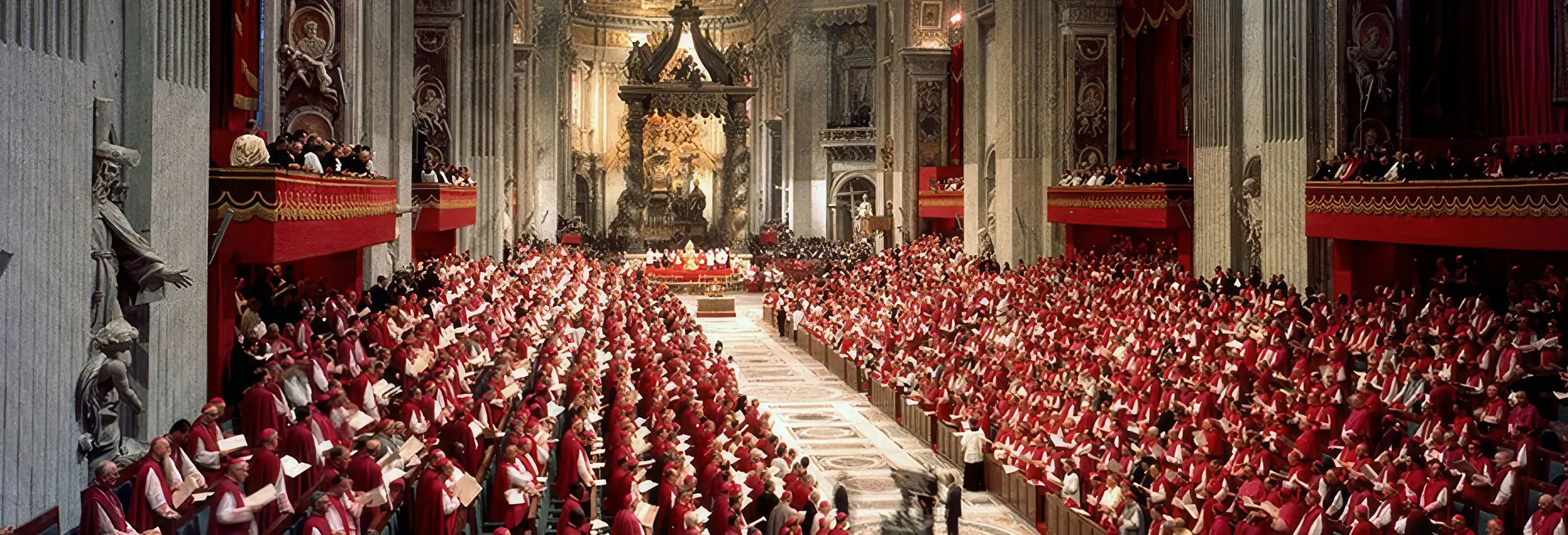
Even before the Duquesne Weekend, however, the prayer of St. John XXIII had already been answered in another marvelous event with worldwide consequences: the Second Vatican Council. Again and again, Pope Francis has urged us not to forget that the Second Vatican Council was itself a great outpouring of the Holy Spirit. Recently, on the occasion of the 60th anniversary of the Council’s beginning, our Holy Father exhorted all of us to “rediscover the Council’s passion and renew our own passion for the Council!”41 I echo those sentiments: let us “renew our passion for the Council!”
How does the Council relate to our Synod? As the Holy Father explained, “The Council helps us imitate God’s approach, which the prophet Ezekiel has described to us today: ‘Seek the lost sheep and lead back to the fold the stray, bind up the injured and strengthen the weak’ (cf. Ezek 34:16).”42
Pope Francis is not the first pontiff to recognize that renewing our passion for the Council is nothing less than renewing our passion for evangelization. It was St. Paul VI, while commemorating the 10th anniversary of the closing of the Council, who reminded the whole Church that “the objectives of [the Council] are definitively summed up in this single one: to make the Church of the twentieth century ever better fitted for proclaiming the Gospel to the people of the twentieth century.”43 While countless debates about the Council have occurred in the last 60 years – and continue to occur today – let us never lose hold of this basic conviction.
St. Paul VI himself courageously put his own conviction into practice by convoking a Synod in 1974 to address the question of evangelization in the modern world (III Ordinary General Assembly), which gave rise to the landmark Apostolic Exhortation, Evangelii Nuntiandi, in which he clearly places evangelization at the heart of the Church:
Evangelizing is in fact the grace and vocation proper to the Church, her deepest identity. She exists to evangelize, that is to say, in order to preach and teach, to be the channel of the gift of grace, to reconcile sinners with God, and to perpetuate Christ’s sacrifice in the Mass, which is the memorial of His death and glorious resurrection.44
The pontiff would go on to clarify that this work of evangelization depends upon the Holy Spirit:
Evangelization will never be possible without the action of the Holy Spirit.… In fact, it is only after the coming of the Holy Spirit on the day of Pentecost that the apostles depart to all the ends of the earth in order to begin the great work of the Church’s evangelization. Peter explains this event as the fulfillment of the prophecy of Joel: “I will pour out my spirit.”45
What is St. Paul VI saying? There would never have been a first evangelization without a first Pentecost; neither can there be a new evangelization without a new Pentecost. Only the fire of the Spirit can overcome our fears and weaknesses. We saw this most clearly with Peter and the Apostles.
44. St. John Paul II: “Be not afraid!”
We’ve spent much of this letter reflecting on the need for evangelization. Yet the very word “evangelization” frightens many. We have to admit today that often we resemble more the pre-Pentecost community of believers, huddled behind closed doors, than Peter and the Apostles afire with the Holy Spirit.
But a great voice reaches us today through those closed doors, saying, “Be not afraid!” It is the voice of St. John Paul II, and it carries a prophetic word: “I sense that the moment has come to commit all of the Church’s energies to a new evangelization and to the mission ad gentes (to the nations).”46 St. John Paul II foresaw a “new evangelization” in formerly Christian regions of the world that would need to be “new in its ardor, methods and expressions.”47 But there is a key aspect of the “newness” of the new evangelization that is often overlooked: its protagonists.
45. The New Evangelization is for all Christians
St. John Paul II is clear that the “Be not afraid!” of the new evangelization is for all the baptized: “The commitment of the laity to the work of evangelization is changing ecclesial life… Above all, there is a new awareness that missionary activity is a matter for all Christians, for all dioceses and parishes, Church institutions and associations.”48 The Holy Father was drawing on the teaching firmly established at the Second Vatican Council in the Decree on the Laity49 and by his predecessor, St. Paul VI.50
46. Pope Francis and the “all” of missionary discipleship
Perhaps nowhere does the “all” of missionary commitment ring out more clearly than in the writings of Pope Francis:
In virtue of their baptism, all the members of the People of God have become missionary disciples (cf. Mt 28:19). All the baptized, whatever their position in the Church or their level of instruction in the faith, are agents of evangelization, and it would be insufficient to envisage a plan of evangelization to be carried out by professionals while the rest of the faithful would simply be passive recipients. The new evangelization calls for personal involvement on the part of each of the baptized. Every Christian is challenged, here and now, to be actively engaged in evangelization; indeed, anyone who has truly experienced God’s saving love does not need much time or lengthy training to go out and proclaim that love. Every Christian is a missionary to the extent that he or she has encountered the love of God in Christ Jesus: we no longer say that we are “disciples” and “missionaries”, but rather that we are always “missionary disciples.”51
You may recall that this key phrase, “missionary disciple,” figured prominently in one of the Focus Areas of our Synod. How good to know that being a missionary disciple is simpler than we think! This is the consoling message of our Holy Father. We need only to have experienced God’s saving love and then begin sharing that love with others according to our talents and spiritual gifts. Can you imagine if every woman, man, young adult and youth accepted these words and embraced this simple calling?
47. Going beyond fear and misconceptions
This universal call of witness might arouse fear in our hearts until we recall that the will of God will never lead us where the grace of God cannot keep us. If it is indeed possible to not be afraid in the face of the Church’s call to mission, it is only because the “all” of the Church’s call is met by the “all” of God’s grace: “To each individual the manifestation of the Spirit is given for some benefit” (1 Cor 12:7). What made Vatican II so potent in its ability to prepare us to evangelize the modern world is that it put these words of our patron, St. Paul, at the forefront of the Church’s consciousness through teachings like the one below from Lumen Gentium:
It is not only through the sacraments and the ministries of the Church that the Holy Spirit sanctifies and leads the people of God and enriches it with virtues, but, “allotting his gifts to everyone according as He wills” (1 Cor 12:11). He distributes special graces among the faithful of every rank. By these gifts He makes them fit and ready to undertake the various tasks and offices which contribute toward the renewal and building up of the Church, according to the words of the Apostle: “The manifestation of the Spirit is given to everyone for profit” (1 Cor 12:7) (Lumen Gentium 12).
If there is fear of the word “evangelization” in many parts of the world today – and maybe even in our own hearts – it may be because we have a very narrow image of evangelization. Perhaps we have the misconception that the universal call of witness requires us all to knock on doors and preach on street corners. Some of us may be called and gifted to do this, but not all. St. Paul explains, “There are different kinds of spiritual gifts but the same Spirit; there are different forms of service but the same Lord; there are different workings but the same God who produces all of them in everyone” (1 Cor 12:4-6).
How good to know that we do not each need to have all the gifts. How good to know that we belong to a body with many members, who can supply in works of evangelization what we are lacking. Moreover, how encouraging it is that our unique giftedness has been foreseen by God for a time such as this (Est 4:14) and is “perfectly suited to and useful for the needs of the Church” (Lumen Gentium 12)!
48. Recognizing our gifts: Vicar for Charisms
Given the importance of both recognizing the gifts that each of us has received and acknowledging that they come from the Holy Spirit, the “principal agent of the whole of the Church’s mission,”52 I have appointed one of our priests to serve as my Vicar for Charisms. I am entrusting him with the task of keeping the fire of Pentecost at the heart of all our prayer, planning, and projects to implement the Synod evangelization in this local church. My hope is that many Synod Evangelization Team members, priests, deacons, consecrated women and men, and laity from throughout the Archdiocese will join him in this effort.
The Vicar for Charisms will be available to all those who feel a deeper call to life in the Spirit. The School of the Holy Spirit will give those who participate the confidence to pray and exercise charisms. This confidence is sorely needed in our local church. There is a powerful witness when a Catholic can lead extemporaneous prayer with someone in need, perhaps even offering prophetic words to console and guide that person on his or her way to the house of the Father.
Some of you who were present for the Pentecost Vigil Mass in the Cathedral this past June have told me that they felt like we were in the Upper Room – a glorious Eucharistic celebration, followed by a time of joyful praise with the exercise of charisms. What if such an experience were not simply a once-a-year celebration on the Solemnity of Pentecost, but rather a regular expression of the Church’s life? Thus would the Upper Room of the past be brought into the present of our Archdiocese, according to the words of St. John Paul II: “Spiritually the event of Pentecost does not belong only to the past: the Church is always in the Upper Room that she bears in her heart. The Church perseveres in prayer, like the Apostles together with Mary, the Mother of Christ, and with those who in Jerusalem were the first seed of the Christian community and who awaited in prayer the coming of the Holy Spirit.”53
Indeed, by centering our Synod in the mystery of Pentecost, I have sought to lead this local church spiritually into the Upper Room. However, as you may recall from the Synod Focus Areas, the hope of the Synod is not only making missionary disciples but also making missionary parishes. In fact, these two hopes go hand-in-hand. To this end I encourage our pastors and their lay leaders to ask themselves this question: Is our parish like the Upper Room? Or have we divided what God has joined? That is, are our people ascending to the Upper Room of the parish each week only for the breaking of the bread and not for the outpouring of the Spirit? At stake is whether or not the fire of Pentecost will empower us to “go forth” from the Upper Room of our parishes.54
I have experienced that many of our bilingual parishes are shining examples of communities that “go forth,” often on behalf of our immigrant sisters and brothers from Africa, Asia, Europe and Latin America who too often find themselves on the peripheries of society. Should we be surprised, for example, to find that the fire of Pentecost is burning brightly in many of our Latino communities? Indeed, many Spanish speaking Catholics report having a profound faith in the power of the Holy Spirit.55 I believe that this is one of the main reasons for the tremendous potential for missionary discipleship that I have witnessed among them. May they inspire us all to “go forth“ in the months and years ahead!
49. The Renewal in the Spirit and the Catholic parish
On the occasion of the 50th anniversary of the Catholic Charismatic Renewal, Pope Francis addressed the members of the Renewal:
Fifty years of Catholic Charismatic Renewal: a current of grace of the Spirit! And why a current of grace? Because it has neither a founder, nor statutes, nor organs of governance. Clearly in this current multiple expressions have been born that are certainly human works inspired by the Spirit, with various charisms, and all in the service of the Church. But this current cannot be dammed, nor can the Holy Spirit be enclosed in a cage!… This current of grace is for all the Church, not just for some, and no one among us is the “master” and all the others servants. No. We are all servants of this current of grace.56
Can we dream of sharing the outpouring of the Spirit with “everyone in the Church” if the outpouring of the Spirit is not an ordinary part of parish life? If the current of grace is for the whole Church, then it needs to be an ordinary part of parish life since the parish is the ordinary experience of Church for the vast majority of Catholics.57
I would like to share a few words of encouragement in particular to our pastors and to their collaborators on parish staffs: let the fire of the Spirit transform the ordinary pastoral work of your parishes! You do not have to do this alone. Your parish Synod Evangelization Team will certainly be with you. Moreover, through the Office of Synod Evangelization and its valued partners (e.g., the Archbishop Flynn Catechetical Institute), you will have opportunities for Schools of Discipleship, of Charisms and of Evangelization. These resources will help your ordinary pastoral ministry to be more animated by the fire of the Spirit.
50. Holy Spirit you are welcome here
In addition, we are blessed with the resources of the many local organizations and movements who in this Archdiocese carry the fire of the Spirit at the heart of their apostolates. I think, for example, of:
- the Archdiocesan Catholic Charismatic Renewal Office and the many affiliated prayer groups, especially prominent in bilingual parishes;
- NET Ministries and its international outreach to high school students;
- St. Paul’s Outreach and its national apostolate to university students and young adults;
- the Totus Tuus summer program for youth;
- the Center for Evangelization and Discipleship (CEND) for young adults;
- Extreme Faith Camp and Damascus summer camp experiences;
- the many programs for discipleship and evangelization (e.g., the Catechetical Institute’s School of Discipleship and its School of the Holy Spirit);
- the annual Twin Cities Steubenville Conferences sponsored by Partnership for Youth;
- the Called and Gifted™ workshops sponsored locally by the Catherine of Siena Institute;
- the many parishes who have introduced Alpha or the Parish System of Evangelization Cells (SCPE), or partnered with Evangelical Catholic or Amazing Parish;
- the Cor Jesu first Friday gatherings sponsored by the Saint Paul Seminary and our Vocations Office; and
- the many new movements and communities that have their origins in the renewal in the Spirit.
I know that many parishes are already collaborating with these groups. I would encourage all parishes to make friends with these friends of the Holy Spirit! If the fire of the Spirit were to become an ordinary part of the life of each parish, what would be the effect? I think Pope Francis paints a vivid picture for us:
The parish is not an outdated institution; precisely because it possesses great flexibility, it can assume quite different contours depending on the openness and missionary creativity of the pastor and the community. While certainly not the only institution which evangelizes, if the parish proves capable of self-renewal and constant adaptivity, it continues to be “the Church living in the midst of the homes of her sons and daughters”.… In all its activities the parish encourages and trains its members to be evangelizers. It is a community of communities, a sanctuary where the thirsty come to drink in the midst of their journey, and a center of constant missionary outreach.58
“A center of constant missionary outreach” … what an inspiring and ambitious vision for our Catholic parishes! Would we be lamenting the decline of our beloved Church if every Catholic parish in this Archdiocese adopted this vision? Some would say this is too bold; I would say this is precisely what our Synod has been all about!