

Weather: Can You Live With It?
Who would have thought that, for several days in late June and early July it has been hotter in Minnesota than here in Venezuela? When it comes to temperature variation, if our part of Venezuela were a merry-go-round, Minnesota would be a rollercoaster. In the course of the year, the temperature here rarely drops as low as 68° or soars as high as 100°. Daytime highs range between 85° and 100°, nighttime lows from 68° to 76°. The Minnesota rollercoaster is a whole different ride. In a typical year the temperature ranges 120 degrees or more. Temps in the Twin Cities have hit 108° (July 14, 1936) and fallen to -41° (January 21, 1888). Statewide, the range has been a scorching 115° to a bone-chilling -60°. As with a rollercoaster, the temperature drops can be rather dramatic. On February 2, 1970, the temperature fell 72 degrees in just 24 hours. Most notorious (ask any Minnesota weather buff), was the Armistice Day blizzard on November 11, 1940. The temperature fell almost 60 degrees in just 12 hours, and 17 inches of snow driven by strong winds buried vehicles in huge drifts.
As far as precipitation is concerned, our part of Venezuela receives 42.68 inches per year compared to 32 inches average in the Twin Cities. Half of our annual rainfall occurs in the 60 days between mid-June and mid-August. We are currently in the middle of the rainy season and can count on the skies clouding up and drenching the earth at least once almost every day. In this, precipitation is more predictable here than in Minnesota, but both locations have their rollercoaster moments.
The summer heat and humidity in southern Minnesota combine to produce an average 27 tornadoes and 30 to 40 thunderstorms each year. For one such storm on the morning of July 23, 1987, Noah would have needed his ark ready. By the time the storm ended the following day, the heavens had dumped 11 inches of rain on the Twin Cities. We have no tornadoes in our part of Venezuela and only an occasional thunderstorm, but we have our own dramatic weather episodes with hurricanes, tropical storms (the same as a hurricane but with winds under 74 mph), and low-pressure troughs. Folks here recall Hurricane Gilbert, one of the largest hurricanes ever, which hit Mexico the hardest but wreaked havoc from the United States all the way down to our area in September of 1988, producing torrential rains with flash flooding. A trough is an elongated cell of low-pressure squeezed between two zones of higher pressure. Troughs several hundreds of miles long can form in the Caribbean with so much warm humid air being drawn up that, when it reaches land, it can dump huge amounts of rainfall over an extensive area for several days. One such trough in 1999 dropped three feet of rain at Maiquetia on the coast in three days. So much rain fell here in our area in early August of 2017 that many low-lying barrios of our parish were flooded for over a month. One woman mentioned seeing a pair of Anacondas swimming through her patio. Another remembers seeing kids, trying to cross the street after school, being swept up in the current.
At Maryknoll’s language school in Cochabamba, Bolivia, we were told that it takes about six weeks to adjust to a new climate. Winter-acclimated and toughened Minnesotans vacationing in Florida hit the beaches while the natives shiver and shake their heads. Here in our parish, it is not uncommon for folks to don sweatshirts when the temperature drops into the mid 80s. I recall that, at an outdoor predawn Mass some years ago, there were folks on the benches shivering although they had down jackets. It was 70° out.
We all have our comfort zones, some broader than others. It´s been known for some Minnesotans to run their furnace one day and their air conditioner the next. On the other hand, I remember folks coming to church in shorts and a t-shirt in the middle of a snowstorm. Over the centuries we have gotten more adept at protecting ourselves from weather extremes. Did people in the past have broader comfort zones or did they just suffer a lot? Probably some of both, be it the weather of Venezuela or that of Minnesota.
Points to ponder
How broad is your comfort zone? Do you stay indoors or get out and get acclimated to the changing seasons?
What do you think it was like for people long ago without air-conditioning or good heating in their homes?
Building a House and a Home
 With significant differences in weather, building materials, financing, and building codes, houses in Venezuela are not constructed in the same way as those in Minnesota. Let’s look first at how a typical house in Minnesota gets built. Prior to building, you need to get a loan from the bank, find a lot, a general contractor, and work out a plan with him of what your dream home will be like. Then the work begins. Bring in a bulldozer and backhoe to dig a basement and trenches for water, sewer, and gas lines. Pour the foundation. Put up basement walls. Install a waterproofing membrane and backfill around the basement. Have it inspected. Get lots of lumber. Rough in the floors and skeleton of the house. Cover the exterior walls and roof with plywood and protective sheathing. Put in windows and exterior doors. Install plumbing, heating, air conditioning, electrical, venting pipes, and ductwork. Pass more inspections. Insulate the exterior walls, basement ceiling, and attic. Hang and tape drywall. Shingle the roof. Finish off the exterior with brick or siding. Paint and finish the interior with doors, cabinets, countertops, and flooring. Install lighting and plumbing fixtures. Pour the steps, walkways and driveway. Grade the yard. Plant grass, trees and shrubs. Pass the final inspection. Move in. Don’t forget to make your monthly mortgage payments for the next 30 years.
Much of what went into building that house was necessary due to Minnesota’s climate which can range from over 100º in summer to -35º in the cold of winter. Here in our part of Venezuela temperatures never go below 65º. Houses don’t need basements, attics, heating systems, insulation, or steeply pitched roofs to keep snow from building up…just enough pitch for water to run off. Here’s how a typical house gets built here. First is finding a lot. Most folks just stay on the same property where their family already lives, building behind or beside their parents’ house. Those moving to a new location either buy an inexpensive lot or just start building on public land and wait to see if the government kicks them off or lets them stay. Chances of getting a homestead in this way are pretty good if the land is rather marginal or if they join in an “invasion” where dozens of families move into an undeveloped area and claim sites at the same time. Next, you´ll need to stockpile building materials…some 2” x 10” wooden planks for forms, loads of sand and gravel, several bags of cement, lots of steel tubing and reinforcing rods and over a thousand cement blocks. Construction will proceed as you are able to purchase these materials, so it may take several months before you can actually begin building. No problem if you’re on the same property as the rest of the family. If you’re in another location, however, you will want to put up a tiny tin shack to hold claim to your site. You’ll need to live there and make sure there is always someone around to keep watch so thieves don’t steal all your building materials.
Once everything is ready, level the area. Dig a trench about a foot deep around the perimeter of the outside walls, construct forms with the wooden planks, mix concrete and pour the foundation. Do the same to build concrete pillars reinforced with steel rods at each corner with one or two more on the longer sides. Run water and sewer lines. Pour the concrete floor. Fill in the walls with concrete blocks, leaving space for doors and windows. Construct the roof support with steel tubing. Add a roof of corrugated metal panels. Put in doors and metal window frames with enough metal bars to keep thieves from breaking in. Connect a cable to the power line in the street and run wiring inside along the ceiling. Break channels in the wall blocks with a hammer to install wiring for electrical sockets and switches. Refill the blocks with concrete. Add electrical and plumbing fixtures. Put a light coat of stucco on the walls if you can afford it. Paint if available. No inspections. Just move in. Forget the bank. With no loan, the house is all yours. When you save up some money, you can put on an addition, a better roof, or a second floor if you made your foundation and posts strong enough. Houses in Venezuela may be different from those in Minnesota, but what makes a house a home is the same everywhere. Parents, providing for and forming their children with strong values, faith, mutual love and respect, don’t just build a house. They build a family, making the humblest hovel or the most splendid castle a home.
Points to ponder
What do you like most about your house? How do you go about making your house a home?
What Makes You Happy?
 “We hold these truths to be self-evident, that all men are created equal, that they are endowed, by their Creator, with certain unalienable Rights, that among these are Life, Liberty, and the pursuit of Happiness.”
When Thomas Jefferson and co-committee members drafted the Declaration of Independence in 1776, they drew on the writings of previous authors who had listed “life, liberty and property” or “life, liberty and security.” Just what did they mean by “the pursuit of happiness” and why did they think it more important than property?
“What makes you happy?” I asked several people in both Minnesota and Venezuela. I realize that the resulting responses may be a bit skewed, since those I surveyed were all people of faith responding to a question by a priest, but not one of them mentioned property, material possessions or money in the list of what makes them happy. Furthermore, despite the social and economic differences between Venezuela and Minnesota, the lists of what makes people happy turn out to be pretty similar. Consider the following:
MN: Being at peace with God and with family.
VEN: The love of God and the health of my family.
MN: An armful of grand babies! I can spend any amount of time just watching them play.
VEN: Having my daughters healthy and happy together with me.
MN: Being around people and helping others…also a good glass of wine while listening to live music.
VEN: Seeing the progress of people in life and knowing that I am doing something good for others.
MN: When I see children and young adults at Mass, especially if it’s an “extra” like a daily Mass.
VEN: That in this time we are learning to value what is most important…the love of God and the unity of our family, things we maybe didn’t take time to focus on before, busying ourselves with so many things.
MN: When I was teaching, one of my greatest joys was talking with kids about books and the love of reading. Today, I continue to share that love of reading with friends and family.
VEN: Spending time with family and friends, planning a little trip with them, or enjoying that magic moment opening a book for the first time without really knowing what is hidden in its pages.
MN: Pretty much everything can make me happy…all kinds of weather, people and God’s creation
VEN: Oneness with the earth, joy in simple things.
Going for a walk with friends, working in the garden, a hug from a friend at the moment you most need it, family get-togethers, a quiet time of prayer experiencing closeness and peace with God. Not a single thing on the lists I received, except maybe that glass of wine, cost a cent. Is it true, then, as the expression goes, that “money can’t buy you happiness?” Maybe, but consider this for a moment. People who don’t have money tend to be more stressed and worry a lot more than those who do. Their life is less comfortable. Such is the reality for our parishioners here in Venezuela, yet they are as happy, if not more so, than folks back in Minnesota.
Money does make life more comfortable. You can buy cool stuff and have lots of experiences. But here’s the problem. People who seem happiness by accumulating things and experiences tend to be far less happy than those who do not. Happiness seems to elude them. In fact, it eludes anyone who pursues happiness itself as their goal. For a good example, check out the story of Zacchaeus in Luke 19:1-10. As a teacher here put it so well, “We spend our lives seeking happiness without really knowing what it is that truly makes us happy.”
True happiness only comes as a by-product, an indirect result, of seeking strong loving relationships with God and others, fulfilling jobs and past-times that put our talents and interests into action, and making a positive difference helping others. Such is the reality reflected in the lists I received. True happiness comes more from focusing on others than focusing on oneself, as one lady here put it: “Seeing my family happy is what makes me happy.” Such is the “pursuit of happiness” that can bear positive results for people everywhere.
Points to ponder
What makes you happy? How can you help other people to experience more happiness in their lives?
¿Qué te hace feliz?
“Sostenemos como evidentes estas verdades, que todos los hombres son creados iguales, que son dotados por su Creador de ciertos derechos inalienables, que entre estos están la vida, la libertad y la búsqueda de la Felicidad”. Cuando Thomas Jefferson redactó la Declaración de Independencia en 1776, fue inspirado por autores anteriores que habían enumerado ““la vida, la libertad y la propiedad” o “la vida, la libertad, y la seguridad”. ¿Qué quería decir con “la búsqueda de la felicidad” en vez de la propiedad o la seguridad?
“¿Qué te hace feliz?” pregunté a varias personas en Minnesota y Venezuela. Es posible que las respuestas resultantes podían ser un poco sesgadas, dado que todas eran personas de fe respondiendo a una pregunta de un sacerdote, pero ninguna de ellas mencionó propiedades, posesiones o dinero en la lista de lo que les hace felices. Además, a pesar de las diferencias
sociales y económicas entre Venezuela y Minnesota, las listas de lo que hace feliz a la gente resultan ser bastante similares. Considere lo siguiente:
MN: Viviendo en paz con Dios y con mi familia.
VEN: El amor de Dios y la salud de mi familia.
MN: Tener mis nietos en los brazos…podía pasar todo el día mirando a ellos jugando.
VEN: Tener a mis hijas sanas y felices junto a mí.
MN: Estando presente a la gente y ayudándolos…también me gusta una copa de vino escuchando a la música
VEN: Ver el progreso de las personas los logros que obtienen, sabiendo que hago algo bueno por los demás.
MN: Ver a los niños y jóvenes asistiendo a la Misa, especialmente una Misa “extra” durante la semana.
VEN: En este tiempo estamos aprendiendo a valorar lo más importante…el amor de Dios y la unión de todos nuestros familiares, cuestión que antes nada tenía tiempo porque vivíamos pendientes en otras cosas
MN: Cuando era maestro, algo que me dio mucha alegría era hablando con los niños de lo bonito de los libros y la aventura de leer. Todavía lo hago con mis amigos y familiars.
VEN: Compartiendo un momento en familia o entre amigos, un viaje corta en su compañía, disfrutando de ese instante mágico de abrir un libro por primera vez sin saber bien qué esconden sus paginas.
MN: Casi todo puede hacerme feliz…todos tipos de clima, de personas y toda la creación de Dios
VEN: La armonía con el ambiente, las cosas sencillas.
Pasear con amigos, trabajar en el jardín, el abrazo caluroso de un amigo justo en ese momento que tanta faltanos hace, un momento de oración experimentando la cercanía y la paz con Dios… nada en las listas, menos quizás esa copa de vino, costó un centavo. ¿Es la verdad, entonces, como dice la expresión, que “el dinero no puede comprar la felicidad“? Tal vez, pero considera esto por un momento. Los que no tienen dinero tienden a vivir más estresadas y preocupadas que los que sí lo tienen. Su vida es menos cómoda. Tal es la realidad para nuestros feligreses aquí en Venezuela, pero todavía son felices, a veces más que la gente de Minnesota.
El dinero hace la vida más cómoda, verdad. Puedes comprar más cosas y tener experiencias bellas. Pero en esto está el problema. Los que buscan la felicidad acumulando cosas y experiencias tienden a ser menos felices que aquellos que no lo hacen. La verdad es que la felicidad elude a cualquiera que la busca como su meta. Mira a la historia de Zaqueo en Lucas 19:1-10. una maestra aquí lo expresó bien: Pasamos la vidabuscando la felicidad y ni siquiera sabemos detectar qué es lo que nos hace realmente felices.
La verdadera felicidad solo viene como un subproducto indirecto de buscar relaciones de amor con Dios y los demás, de realizar trabajos y pasatiempos que pongan en acción nuestros talentos e intereses, en particular al servicio de los demás. Tal es la realidad reflejada en las listas que recibí. La verdadera felicidad viene más de centrarse en los demás que de centrarse en uno mismo, como dijo una señora aquí: “Ver a mi familia feliz es lo que me hace feliz”. Eso es “la búsqueda de la felicidad” que puede resultar exitosa para todo el mundo.
Puntos a considerar
¿Qué te hace feliz? ¿Cómo puedes ayudar a otras personas a experimentar más felicidad en sus vidas?
Talk About Food Prices!
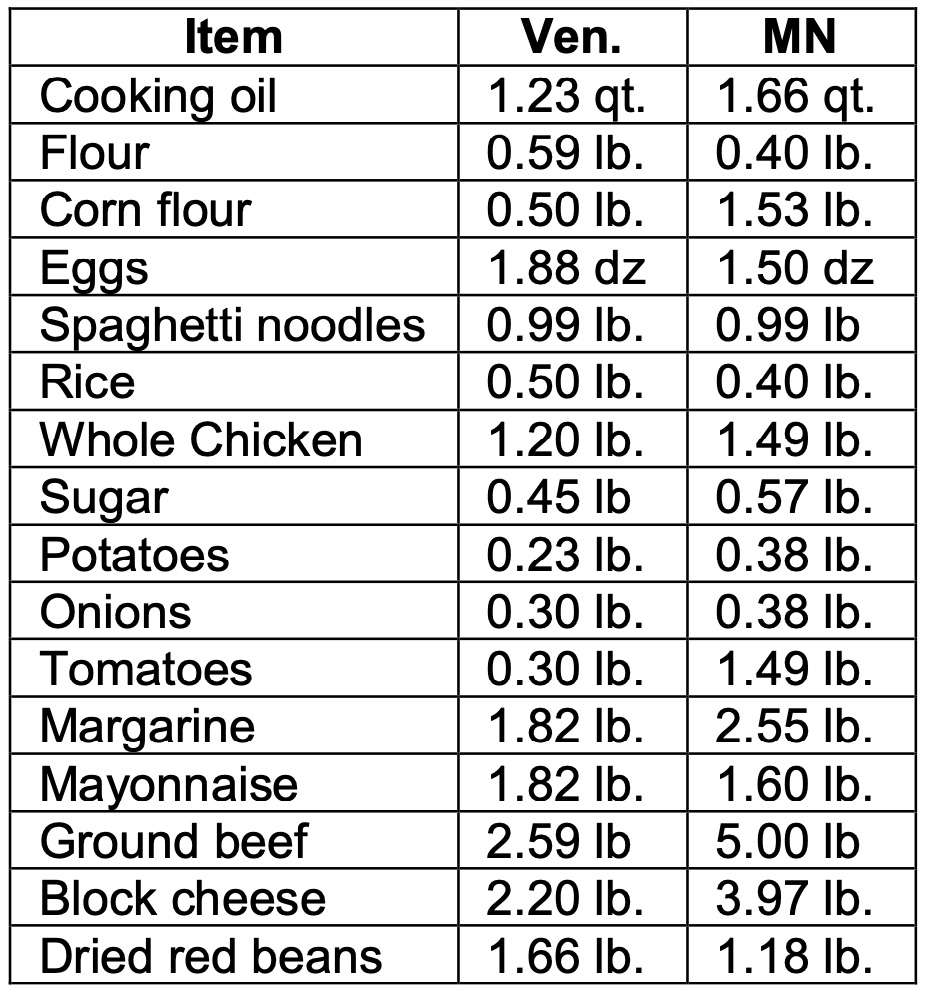 Conversations these days in both Venezuela and Minnesota inevitably gravitate to the coronavirus and social distancing restrictions, but what about back in “normal” times? In Minnesota the go-to topic is weather. With temps into the 90’s almost every day, people here do comment on the heat, but what really gets people talking is the price of cooking oil, sugar and rice. When was the last time you had a lively discussion over such things? Probably never, I’d guess, but this is Venezuela where people spend most of their income on food. Once they get rolling, people often become more animated, moving on to the price of eggs, milk and chicken.
I did a cost comparison this past week of the basic food items in the Venezuelan basket, converting various sized packaging to the price per pound, quart and dozen. The Venezuelan prices are what we pay buying in volume at a place similar to Sam’s Club or Costco. Most people here don’t have access to such stores, lacking a vehicle to get there and cash
on hand to buy in volume, and generally pay at least 25% more at local stores. Minnesota prices are as advertised last week for online shopping at Cub with the exception of potatoes and onions which, as you know, are always cheapest at Kwik Trip. You may wonder why I didn’t include frozen pizza, ice cream, baked beans, tuna, or other items which would have been on my shopping list back in Minnesota. I haven’t seen a frozen pizza since arriving in Venezuela nine months ago, tasted ice cream just once, and have yet to eat or even see food that comes in a can. The average Venezuelan family eats little or no processed food.
Contrary to what folks in Minnesota had heard in the past, there is no food shortage here. Even neighborhood shops are well-stocked. Such was not the case here three years ago when, with skyrocketing inflation, the government set price limits on basic food items. Merchants couldn’t purchase those commodities for less than what they had to sell them, so store shelves were empty. The current issue is not availability but affordability.
The median annual household income in Minnesota in 2018 was a bit over $70,000 of which around 12% or $8,400 was spent on food with approximately $4,800 being food at home and $3,600 at restaurants. Although the typical family in our parish hasn’t eaten at a restaurant for years and has a much simpler, less expensive shopping list when going to the market, they spend nearly 100% of their income on food. How can that be?
The minimum salary here is currently around $3 a month, obviously not enough to feed a family for a few days much less an entire month. To retain good workers, most companies give employees an additional monthly bonus of $20 to $30. Those with a “Carnet de la Patria” (homeland card), which the government began issuing in 2016, receive around $3 every couple weeks deposited to their bank account and a box of basic food items distributed by the government every 2 or 3 months. The downside is that the card can be used to track votes in elections. Concerned that the card is really a political tool for buying votes, many people don’t apply for one.
More than 5 million Venezuelans have left the country in the past five years, adding another important source of support for families in the form of money sent from foreign countries. Venezuela allows transfers up to $100 at a time through DHL, UPS, and Western Union from which a commission of around $20 is deducted. Unfortunately, not every family has relatives in foreign countries to support them. Not all apply for a homeland card. Many workers, public school teachers included, receive only the basic salary with no monthly bonus, and those retirees who qualify for a government pension only receive the equivalent of around $1.50 a month. So, next time you get to talking with your friends and neighbors, after reviewing the latest on the coronavirus and the Minnesota weather scene, consider adding the price of cooking oil, sugar and rice to your conversation and why, for many of our Venezuelan people, those prices are the major conversation starters every day.
Points to ponder
What percentage of your family income do you spend on food? What would you remove from your shopping list if you had to cut way back on food purchases? What about eating out?
Hablando de los precios de los alimentos
 Las conversaciones en estos días tanto en Venezuela como en Minnesota inevitablemente gravitan sobre el coronavirus y las restricciones de distanciamiento social, pero ¿de qué se habla en los “tiempos normales”? En Minnesota el tema más común es el clima. Aquí en Venezuela la gente comenta sobre el calor, pero lo que realmente se enfoca la conversación es el precio del aceite, el azúcar y el arroz. ¿Cuándo fue la última vez que tuvieron una animada discusión sobre estas cosas? Probablemente nunca, pero esto es Venezuela donde la gente gasta casi todos sus ingresos en comida. Una vez que se caliente un poco, la conversación pasa animadamente al precio de los huevos, la leche y el pollo.
Hice una comparación en cuanto cuestan los alimentos básicos entre las tiendas en Venezuela y Minnesota donde se puede conseguir los precios más baratos, convirtiendo todo en dólares US. Los precios dados por Venezuela son los que pagamos en tiendas donde salen más baratos por comprar en volumen. La mayoría de la gente no tiene acceso a tales tiendas por falta de un vehículo para llegar allí y de dinero suficiente para comprar en volumen, y generalmente pagan por lo menos 25% más en las tiendas locales. Posiblemente me preguntarán por qué no incluí pizza congelada, helado, frijoles y atún en lata, y otros cosas que siempre tenía en mi lista de compras en Minnesota. La verdad es que no he visto una pizza congelada desde cuando llegué a Venezuela, he probado helado una sola vez, y no he comido ni visto comida que viene en lata. La familia venezolana come muy poco o nada de los alimentos procesados.
Hace tres años había un terrible escasez de alimentos aquí. Con una inflación galopante, el gobierno fijó límites de precios en los alimentos básicos, resulto que los comerciantes no podían comprarlos por un precio más barato de lo que tenían que venderlos y, por eso, los estantes estaban vacíos. Hoy en día, todas las tiendas están bien surtidas. El problema actual no es la disponibilidad sino la asequibilidad de los alimentos.
El promedio de los ingresos anuales de las familias en Minnesota en 2018 era un poco más de $70.000 US de que gastaron 12% ($8.400) para la comida en la casa ($4.800) y en restaurantes ($3.600). Las familias de nuestra parroquia no come en restaurantes y su lista de compras es mucho más sencillo que la de la gente en Minnesota. Sin embargo, gastan casi todos sus ingresos en comida. ¿Cómo puede ser eso?
El sueldo mínimo en Venezuela es de alrededor de $3 US al mes. Eso no es suficiente para alimentar a una familia por una semana, mucho menos un mes entero. Para retener a los buenos trabajadores, la mayoría de las empresas dan a los empleados un bono adicional de $20 a $30 mensual. Los ciudadanos con un “Carnet de la Patria” reciben alrededor de $3 cada mes depositado en su cuenta bancaria y una caja de alimentos básicos distribuidos por el gobierno cada 2 o 3 meses. El problema es que la tarjeta puede ser utilizada para rastrear los votos en las elecciones y, por eso, mucha gente no la solicita. Más de 5 millones de venezolanos han dejado el país en los últimos cinco años, añadiendo otra importante fuente de apoyo a las familias en forma de dinero enviado desde el extranjero. Venezuela permite transferencias de hasta $100 US a la vez a través de DHL, UPS y Western Union de las cuales se deduce una comisión de unos $20 US.
Desafortunadamente, no todos tienen familia en países extranjeros que las apoyen. Muchos trabajadores, incluidos los maestros no reciben más del salario básico sin bonificación mensual. Los jubilados que califican para una pensión del gobierno sólo reciben alrededor de $1.50 al mes. Por eso, la próxima vez que hable con sus amigos y vecinos, después de revisar lo último sobre el coronavirus y el clima de Minnesota, considere incluir en su conversación el precio del aceite de cocina, el azúcar y el arroz y por qué, aquí en Venezuela, esos precios son los principales temas de conversación todos los días.
Puntos a Considerar
¿Qué porcentaje de los ingresos de tu familia gastan en comida? ¿Qué eliminarían de su lista de compras si tuvieran que reducir las compras de alimentos? ¿Qué hay de comer en restaurantes?
